
Diesel brake tender Profile and Models
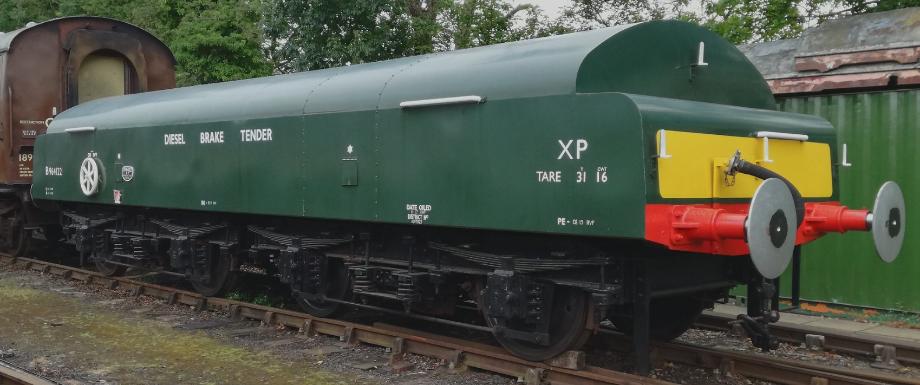
B964122 at Rothley in July 2019. ©Dave Bower
Diesel Brake Tender
 |
|
|
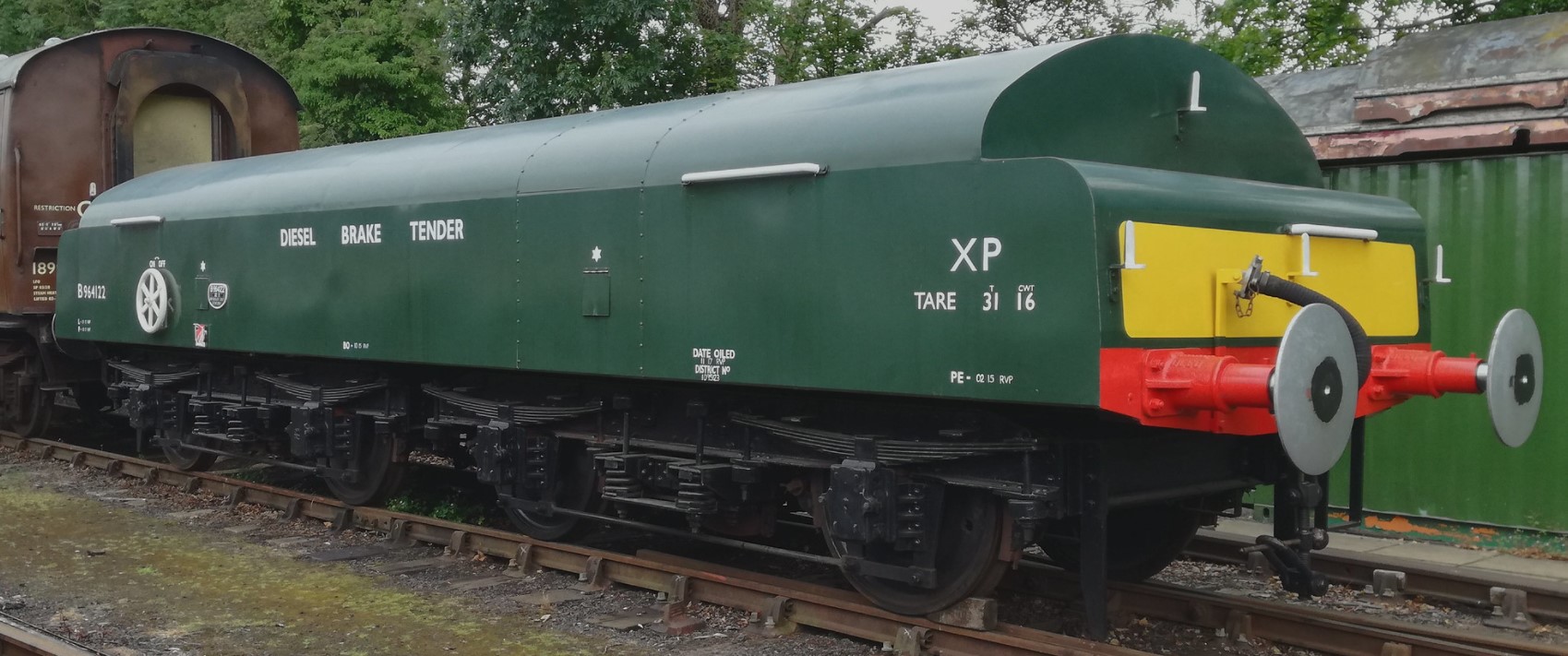
B964122 at Rothley in July 2019. ©Dave Bower British Rail discovered that their newly introduced diesel locomotives in the 1950s and 1960s had insufficient braking force on trains of unfitted goods wagons. This was due to diesel locomotives being lighter than their steam counterparts, which provided greater tractive effort at a cost of lesser braking ability. The solution was to produce a fleet of small tenders, which took the form of a hollow box mounted on a frame with a pair of former carriage bogies. They were low enough so not to obscure the driver's view when being pushed but could also be pulled directly behind the locomotive. The practice of using unfitted goods trains was phased out in the 1980s and all diesel brake tenders were scrapped as a result. In 2017, a replica tender was produced at the Great Central Railway using remnants of a Mk1 corridor coach and was given the next number in the brake tender sequence - B964122. |
|
|
Type of Vehicle |
Diesel Brake Tender |
|
Builder |
British Rail |
|
Build Dates |
Early 1960s (+ 1 replica in 2017) |
|
Total Built |
122 (+1 replica) |
|
Wheel Configuration |
2 x Bogies |
|
Operated By |
British Rail |
|
Main Duties |
Additional braking for diesel locomotives |
|
In Service Until |
1980s |
|
Surviving Examples |
All Scrapped (1 replica produced) |
or reload the browser
OO Gauge (1:76 Scale)

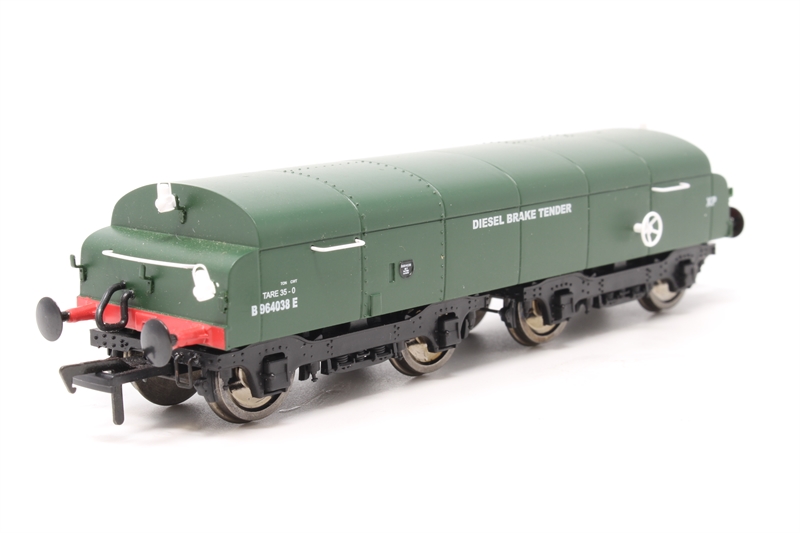
 BR plain green
 BR green with late crest
 BR blue
Products awaiting categorisation
| Scale | Brand | Image | Construction Type | DCC Capability | Product Code | Product Title | Livery |
|---|---|---|---|---|---|---|---|
| OO Gauge (1:76 Scale) | Dapol |
|
RTR/RTUse/Pre-assembled | Not set |
HM-DBT-016 View |
BR Diesel Brake Tender B964116 in BR Dark Blue FYE (Limited Edition for Key Publishing) | Awaiting Categorisation |
| OO Gauge (1:76 Scale) | Genesis Kits |

|
Requires assembly | Not set |
DBT2 View |
Diesel brake tender kit (short round type) (Wheels and bearings not included) | Awaiting Categorisation |
| OO Gauge (1:76 Scale) | Kitbuilt (unknown brand) |
|
RTR/RTUse/Pre-assembled | Not set |
KB141 View |
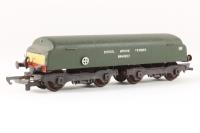
Diesel Brake Tender B964017 in BR green - scratchbuilt | BR plain green |
| O Gauge (1:43 Scale) | GJH Plant Company |

|
Requires assembly | Not set |
RTV-GJH View |
BR RTV Diesel Brake Tender kit | Awaiting Categorisation |